

Issue #7: When Humans Stopped Thinking.
In this edition: 1968, humanity, NASA, & quiet surrender.

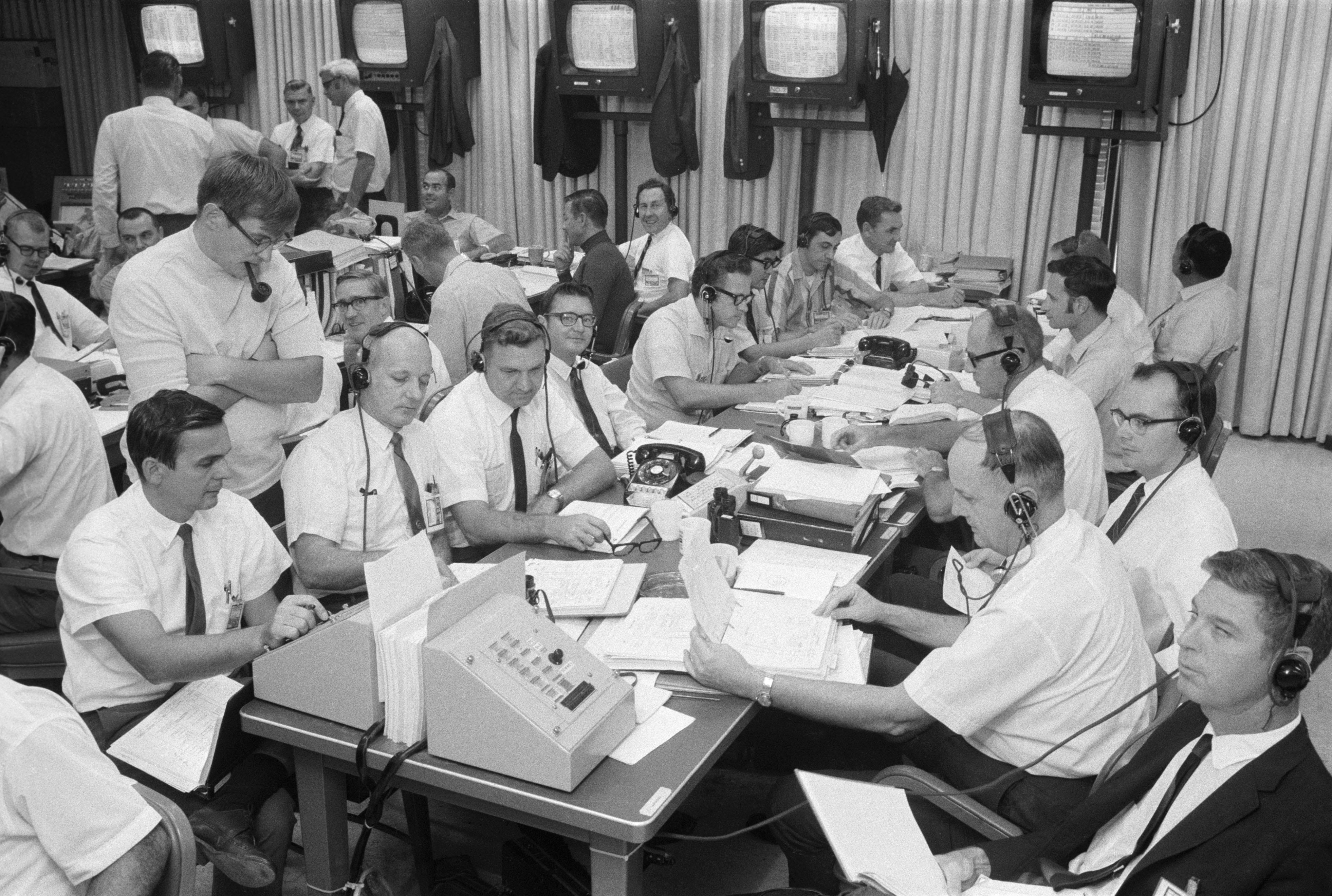
The photograph above is from the Apollo mission, and almost sixty years later, people still talk about it. It shows a room full of NASA’s finest engineers, at desks, heads down, each one working through orbital mechanics by hand. Slide rules. Graph paper. Pencils. Every trajectory calculation for the Apollo missions passed through human minds before it passed through machines.
At this time, these brilliant minds were called them “human computers”, but when the machines got good enough, humans literally stepped back.
Obviously, nobody announced it as a loss. In fact the efficiency gain was embraced and framed as progress, but something else happened quietly. Lol. Within two decades, the knowledge of how to do those calculations manually had largely left the building. It lived in the machines now.
Well, Apollo 11 landed on the moon, and the machines were right, but pay attention to the event dynamic, because it is with much higher stakes.
When a tool becomes good enough, many people decide to stop thinking.
With machines, the decision is distributed across a million small moments of convenience. From depending on a GPS instead of memorizing the route, to using a calculator for simple addition, or even drafting the first version of your article using an AI model instead of your brain.
Each individual choice is rational. The aggregate is something else.
Your brain, soon stops maintaining what it no longer needs to produce, and slowly, the skillsets start eroding, gradually, then completely. Psychologists call this cognitive offloading.
Today, we have more serious issues than offloading navigation or arithmetic. We are offloading the very processes that made human knowledge worth encoding in the first place. Stuff like reasoning, synthesis, judgment, discretion.
AI systems learn from human-produced thought, With a finite amount,
This matters because AI doesn’t generate knowledge with training data as the sediment of centuries of human cognition. Thing is, that sediment is limited, and we are not replacing it at the rate we are consuming it. At this point, we already know what happens to machines: a collapse in variation, & brittle outputs with almost no semblance to reality.
The less-asked question is what happens when humans stop thinking? The answer, is atrophy in very small ways. In fact, you are already familiar with many of these cases.
Today, students who can produce a well-structured essay with ChatGPT, but cannot hold the argument together in a conversation. Many developers can ship code they cannot explain. Analysts can now generate a report, yet struggle to interrogate its assumptions. Strategists who outsource the thinking and then wonder why their decisions feel hollow. On a lighter note, adults who genuinely can go nowhere without navigation apps.
Of course, these guys never made a single dramatic choice, because, let’s face it, these tools are pretty useful, but the thing is:
Humans build underlying capacity because of friction in processes.
Yes, the result of these missing elements can best be managed at the scale of individual skills, but at the institutional level, it becomes fragile. Talk less of what happens to civilization. AI risk conversations mostly focus on what AI might do to us. Maybe we should be asking what the lack/absence of thinking is doing to us.
You see, when a model produces a wrong answer you can fix, audit, correct, retrain it. However, when a generation of people have lost the capacity to recognize a wrong answer is a much harder problem.
I wish that was a speculation, sadly, it is already the direction of travel.
The NASA engineers who handed off to machines built verification into the process, and outsourced calculation, not judgment. That distinction matters, because you should use these modern agents, tools to handle volume, but make sure to interrogate assumptions, argue with the output, and own the synthesis.
In essence, you should nurture the ability to independently produce original observations, have meaningful conversations, hold complex arguments, and recognize when a well-sounding output is completely wrong. Because that capacity requires use, and otherwise, both the tools and users will collapse inward on themselves.
Sources & Good Reads:
Cognitive offloading and its effects on memory: Risko & Gilbert, Trends in Cognitive Sciences
Model Collapse: Shumailov et al., Oxford, 2024
Apollo’s human computers: NASA History Division
Mission Evaluation Room: Wikipedia
